

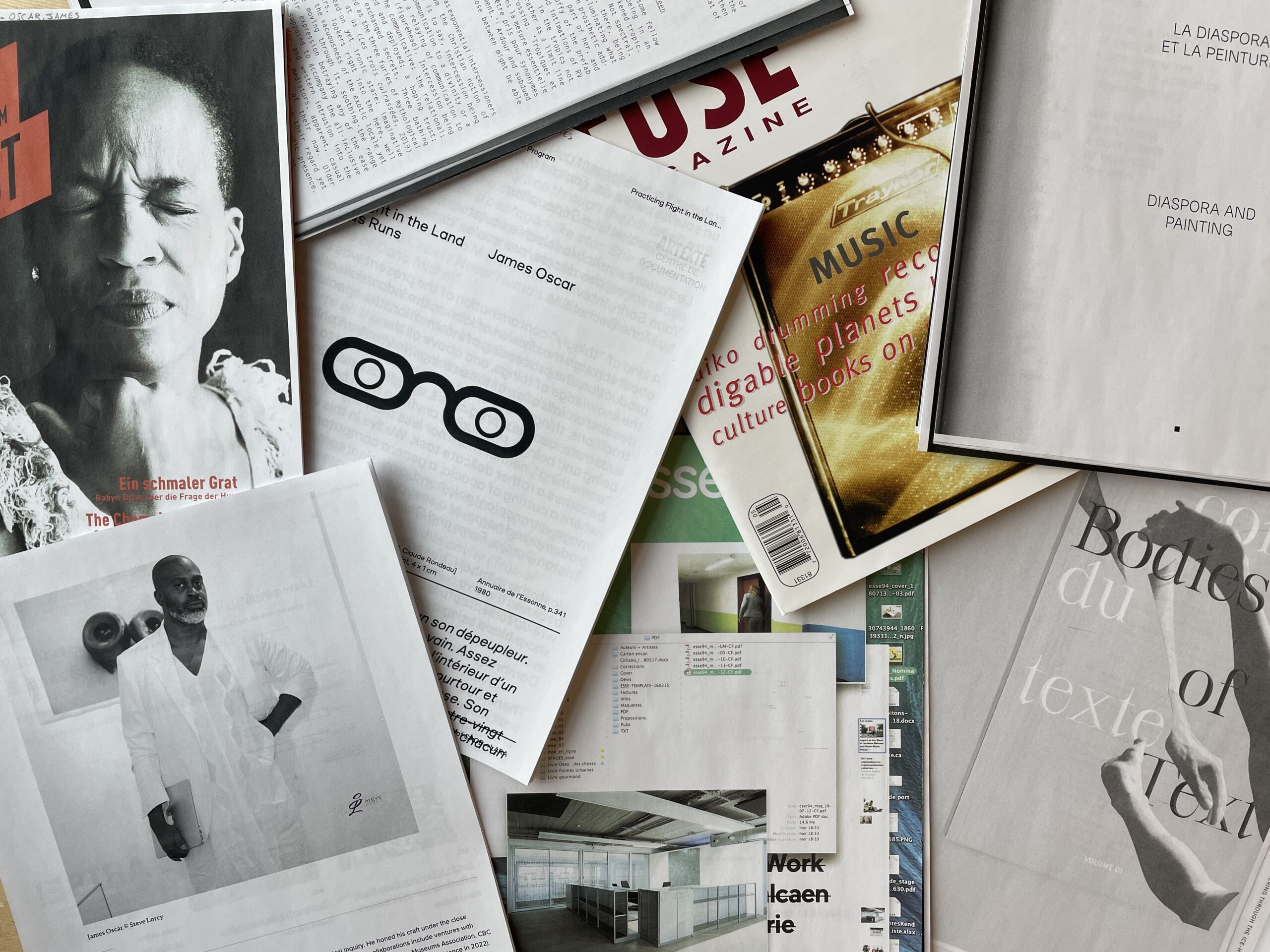
The first essay in this series, which forms a chapter in my latest book released in August 2022 and written to accompany my writer file at Artexte, explores an exhibition that resonated with my most recent interests as an art critic. To recapitulate, extract, and remix aspects of that text for context, these interests include: “transversal actors working in the chasm—protagonists silently intimating the chassis underneath violence,” social actors attuned to a certain sub-violence—the discreet, underlying violence [1] that permeates our societies just beneath the surface of the everyday.
Poetic language speaks to those who navigate the social with a certain hybridity, possessing the ability to articulate and illuminate such violence/sub-violence. The artist (Catherine Morin) I wrote [2] about portrays quasi-preternatural beings as they gesture toward, pose within, and inhabit the strata beneath an implied violence. My fascination with these figures—those who operate “underneath” and in between, so to speak—stemmed from an interest in “regimes with undercurrents of violence, and what I named as the sub-violence as a lesson in the discretion of regimes.” This sub-violence manifests in the how and the what of political, economic, or social structures as they execute social control through subtle means, always containing within them a “static and potential violence.”
What drew me to the personae in that painter’s work was how they evoked a vanguard of resistance—figures who navigate oppressive structures and find ways to persist. They embody a form of resilience, appearing as if they herald future possibilities: “A figure appearing before the horizon feeling like a possible facilitator of future horizons.” A kind of utopian perspective, made tangible by the artists I write about.
In my second essay, which brings me back to my first professional article, written in 1994, I too had an interest in this hybrid figure and spoke of what I referred to as my imaginary group: the “young black Hegelians” [3]—no doubt flyboys in the buttermilk, like Jean-Michel Basquiat. In that first interview, I spoke with the artists Digable Planets, who spoke to me of “new spaces,” which resonated with me very much, as a young writer at that time. Their performances were “spirit guides” for our in-between universes, aligned in the fight for alterity. They mustered the in-between for certain people of colour—but an in-between that did not lack a certain grounding.
In considering the long stretch between 1994 and 2025, I see thirty-one years of similar affinities and definitive interests as I looked to artists offering their (so to speak) views from the threshold. I have written about other such artists along the way, such as Dana Michel [4] or, more recently, Miles Greenberg. [5]
And thus, a thirty-one-year career of searching through fields of liminality, so to speak—of observing artists who constantly cross thresholds in the express goal of advancing the world through their interior landscape: emergent artistic practices and emergent beings.
For this final post, I will return to my original form of writing—poetic fragments, as I was trained by the poet Edouard Glissant—and present a remix of some unpublished work alongside my third entry for the Artexte collection, an article titled “Each Revolution Has Its Methods.” The following poetic fragments speak to these emergent artists and beings, whom I have tracked for thirty-one years.
Beings emergent from the sea.
—Pablo Neruda
His house, still bent in his palm is everything.
It is the Night, it is the Time,
It is the Whole Curve of a benefit gone wild,
with the fronds of white sculptured flowers on brick leaves
—James Oscar
And after the lights were out, the first thing we all saw was the long drawn bicycle streaming through the night like vehicles in the emollient freedom before the bomb. After the fall, the first thing we saw was the one rider streaming like a red dart through a setting sun. [6]
—James Oscar
Part 1
The mid-gaze between literal movement’s contemplation and its fulfillment—a space located in the periphery from shadow to foreshadow, from fore shadow to shadow—deep in the resilience of shadows
The gaze down the middle, the gaze that stops in midstream to shed, and throw light, or provide the whole of a horizon
The exchange, the reprisal of the shadow met with another, the opening and at times frightening gaze which starts it all.
Not totally in the resilience of the shadows but rather in the embers which come and reform the shadows, continuously repositioning them, reconstituting them, replacing them, positing them as correspondences and possible real forms of present likenesses.
Positing this strength, as in a shadow (the shadow containing past and future fossil—necessarily beyond itself) and as in the purpose to contravene with the shadow—that is, in its resilience.
The resonance and resilience [of the shadow] is not so much before and after, but in its “midness,” in its present living in the present. The shadow, bereft, stepping in and out—realizing “its” darkness but ultimately seeing in its embers what can continuously reconstitute it at various moments and junctures.
To the extant of crossing the divide, pursuit of that one stridulant movement which can mark no beginning nor end but rather a total lapsus, a moment with a median, a mid point, lapsus which is continually passed through (from each side), and at once, and in a certain moment it allows its centre to also be transfigured from above and below, above and below, above and below—it ultimately becomes a circle continuously filled—till full, then another circle, another and another
Part 2
Maps and the rotations of globes, as full radiations,
As Time’s Cause, revealed in just a few of the light’s railed time.
Pointing to the effluvium of light.
Effluvium time’s spell, to bend and yet reveal.
And yet the un-giving is in the agent, the actor staid, Drowning in his pallor of the moment—doting it, arranging it, Like temporary artifice, “for grander turns in temporary horizons”
A beginning returns rotund
And reveals, even if in just one slight of the radiations, a revolution or histories hurled—seen through, Understanding the solidity of something,
Entering into a foundry of time.
“I knew this when I was leaving in the distance, the foray. I knew this before I came to this welt of country, ‘The swell building in lyes,’”
And the green verdure which was never there.
The fount of disappointment, a bleak fount, the possible squared.
Fount, the hexagon gone diametrical.
“I knew this when I was leaving in the distance, and the foray. I knew the fount was far
For instance, at the front of this particular train,
With the light leading, and pulling in the distance,
And at once repair, extraordinary human beings.”
…